
Posted on July 21, 2026
You have a tooth that hurts. You know exactly where the pain seems to be coming from. Maybe it's a deep ache in a molar, a sharp pain when you bite, or a throbbing sensation that just won't go away.
Naturally, you assume you need to visit a St. Catharines dentist for a filling—or perhaps a root canal.
But what happens when your dental X-rays look normal? There is no obvious cavity, crack, or infection. Yet the pain is still very real.
This can be incredibly frustrating. It can also leave you wondering: Why does my tooth hurt if my dentist can't find anything wrong with it?
The answer may be that the pain isn't actually coming from the tooth.
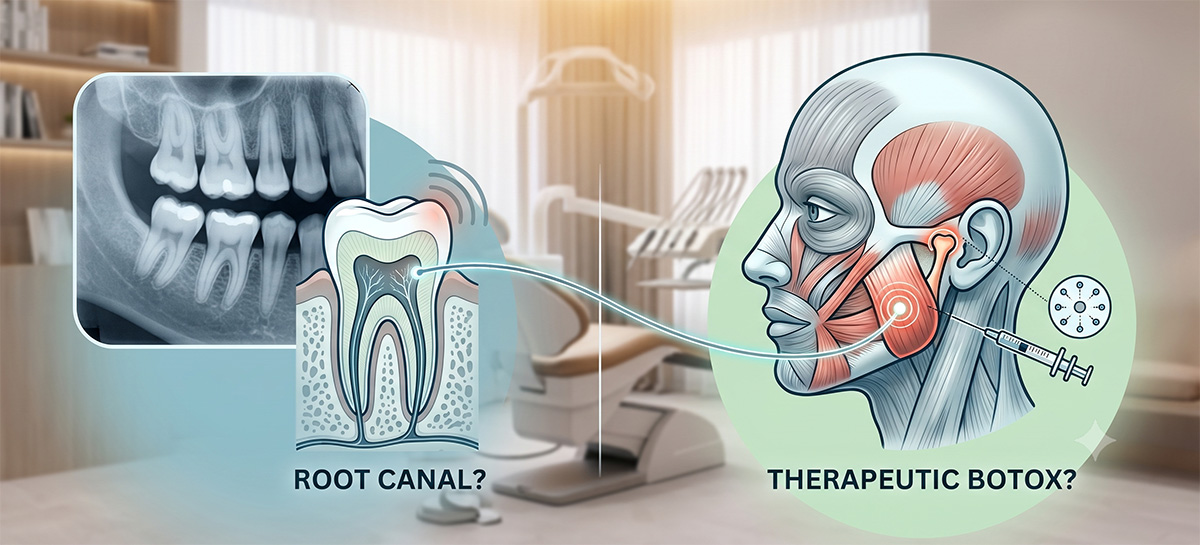
Pain from the muscles of your jaw, your temporomandibular joint (TMJ), or other areas of your face can sometimes feel exactly like a toothache. This is called referred pain. Your brain knows that something hurts, but it may not always correctly identify where the pain started.
For some people, chronic jaw clenching or teeth grinding can cause the muscles of the jaw to become overworked and painful. That pain can then be felt in the teeth.
In these cases, a root canal won't solve the problem because the tooth itself isn't the source of the pain. Depending on the cause, treatment may instead focus on the jaw muscles, and therapeutic Botox may be one option for some patients.
So, how do you tell the difference?
The Mystery Toothache: When Dental Pain Isn't a Tooth Issue
One of the most frustrating experiences is having ongoing tooth pain while being told that your tooth looks healthy.
The good news is that "nothing is wrong with your tooth" does not mean your pain isn't real.
Your teeth, jaw muscles, jaw joints, and facial nerves are all closely connected. The main nerve responsible for sensation in your face, called the trigeminal nerve, carries signals from many different areas. Because these areas share some of the same nerve pathways, pain from one location can sometimes feel as though it is coming from another.
For example, an irritated jaw muscle may cause pain that feels like it's coming from a molar. Problems with your TMJ may cause pain around your jaw or ear. Even sinus problems can sometimes make your upper teeth feel sore.
This can make diagnosing the true source of your pain challenging.
You may want to talk to your dentist if you have:
- Ongoing tooth pain but clear X-rays
- Pain that seems to move from one tooth to another
- Several teeth that hurt at the same time
- Jaw tightness or soreness
- Morning jaw pain or headaches
- A history of clenching or grinding your teeth
- Pain that gets worse during stressful periods
- Facial muscles that feel sore or tender
- Dental treatment that hasn't relieved your pain
In these situations, your dentist may need to look beyond the tooth itself.
That doesn't mean you don't need a root canal. It simply means the source of your pain needs to be carefully identified before deciding on treatment.
Identifying Root Canal Problems: Signs the Pain Is Coming From Inside the Tooth
A root canal is used when the soft tissue inside a tooth becomes badly inflamed or infected.
This can happen because of deep decay, a crack, trauma, or other damage to the tooth. When the nerve inside the tooth is no longer able to heal itself, root canal treatment may be needed to remove the damaged tissue and save the tooth.
Your dentist may perform several tests to determine whether the tooth itself is causing your pain.
These may include:
- Cold or heat testing
- Checking how the tooth responds when gently tapped
- Having you bite down on the tooth
- Looking for cracks or damage
- Checking the surrounding gums
- Taking X-rays or other images when needed
Temperature Sensitivity and Localized Throbbing
Certain types of pain can suggest a problem inside the tooth.
For example, a tooth with significant inflammation may become very sensitive to hot or cold. The pain may continue for a while after the hot or cold stimulus is gone. Some people experience spontaneous throbbing or pain that becomes worse when lying down.
Other possible signs of a problem inside the tooth include:
- Pain when biting or chewing
- A tooth that is very sensitive to pressure
- Swelling around the tooth
- A small bump or drainage on the gum
- A tooth that has become darker in colour
- Changes around the root of the tooth visible on an X-ray
However, everyone's symptoms are different. Some seriously damaged teeth cause very little pain, while other types of pain can be severe even when an X-ray looks normal.
That's why your dentist needs to consider the full picture rather than relying on one symptom or one X-ray.
Identifying Jaw Muscle Tension: How Clenching Can Feel Like a Toothache
Now imagine a different situation.
Your X-rays look normal. Your tooth responds normally to testing. There is no obvious cavity or infection. But you still have a deep ache that feels like it's coming from one of your molars.
At the same time, you notice that your jaw is often tight. You may clench your teeth during the day or grind them at night. Perhaps you wake up with a sore jaw or headache.
In this situation, your pain may be coming from your jaw muscles rather than your tooth.
The masseter muscle is one of the main muscles you use to chew. It's located along the side of your jaw and works very hard when you chew, clench, or grind your teeth.
If this muscle is constantly working too hard, it can become tense, tired, and painful. This can contribute to jaw pain, facial soreness, headaches, and even pain that feels as though it is coming from your teeth.
This is sometimes called myofascial pain—simply put, pain that comes from the muscles and the tissues around them.
Why Muscle Pain Can Feel Like a Cavity
The tricky part is that muscle pain doesn't always stay where the muscle is located.
Tight or irritated muscles can send pain signals to other areas. This is known as referred pain.
For example, a sore jaw muscle may cause you to feel pain in your upper or lower molars. You may be completely convinced that you have a toothache, even though the tooth itself is healthy.
Some clues that your pain may be coming from your jaw muscles include:
- Pain that gets worse after chewing
- Soreness after long conversations
- Jaw pain or fatigue
- Frequent clenching or grinding
- Headaches around your temples
- Pain that is worse during stressful times
- Tenderness when your dentist presses on your jaw muscles
Of course, it's possible to have both a dental problem and jaw muscle tension at the same time. That's why a thorough examination is so important.
How Therapeutic Botox May Help Non-Tooth Pain
If your dentist determines that excessive jaw muscle activity is contributing to your pain, treatment may focus on reducing that muscle tension.
This is where therapeutic Botox may be an option for some patients.
Botox works by temporarily reducing the strength of muscle contractions. When used in the jaw muscles, it can help reduce excessive muscle activity caused by chronic clenching or grinding.
The goal isn't to stop your jaw from working normally. Instead, the goal is to reduce excessive muscle activity that may be contributing to pain and discomfort.
For appropriately selected patients, therapeutic Botox may help with:
- Jaw muscle tension
- Facial soreness
- Pain associated with clenching
- Some muscle-related headaches
- Excessive force placed on the teeth
- Certain symptoms associated with TMJ disorders
It's important to understand that therapeutic Botox is not a replacement for a root canal when a tooth is infected or has significant damage to the nerve.
The two treatments address very different problems.
- Root canal therapy treats a problem inside the tooth.
- Therapeutic Botox may help when overactive jaw muscles are contributing to pain outside the tooth.
This distinction is extremely important. If a healthy tooth is treated with a root canal when the real problem is muscle tension, the pain is unlikely to go away.
Similarly, Botox cannot treat an infected tooth.
The first step is always figuring out where the pain is actually coming from.
The Differential Diagnosis Protocol at Creek View Dental
At Creek View Dental, we believe that the right treatment starts with the right diagnosis.
When you're experiencing persistent tooth or facial pain, we take the time to look at the whole picture.
- We listen to your symptoms: Your description of the pain provides important information. When did it start? Is it constant or does it come and go? Does hot or cold make it worse? Does chewing trigger the pain? Do you wake up with a sore jaw? Does stress make your symptoms worse? These details can help us understand where to look.
- We examine your teeth: We'll check for cavities, cracks, damaged fillings, gum problems, and other potential causes of tooth pain. We may also test how individual teeth respond to temperature and pressure to determine whether the tooth itself is likely to be the source.
- We review your X-rays and other images: X-rays can help identify decay, infections, bone changes, and other dental problems. However, a clear X-ray doesn't necessarily mean your pain isn't real. It may simply mean we need to consider other possible causes.
- We check your jaw muscles: We may examine the muscles you use for chewing, including the masseter muscle. If these muscles are unusually tight or tender—or if pressing on them reproduces the pain you thought was coming from your tooth—that can provide an important clue.
- We evaluate your TMJ: Your temporomandibular joint (TMJ) connects your jaw to your skull and allows you to open and close your mouth and chew. Problems involving the jaw joint or surrounding muscles can sometimes cause pain in the jaw, face, ear, head, or teeth.
- We consider other causes: If your teeth appear healthy but your pain continues, we may consider other possible causes of non-odontogenic pain, meaning pain that isn't coming from the teeth. Depending on your symptoms, this could include jaw muscle problems, TMJ disorders, sinus issues, nerve-related pain, or other conditions. If necessary, we may recommend seeing another healthcare professional or specialist.
- We recommend treatment based on the diagnosis: Once we have a better understanding of what's causing your pain, we can recommend the appropriate treatment. If a tooth has significant damage or infection inside it, root canal therapy may be the right solution. If your pain is related to excessive jaw muscle activity, your treatment plan may include strategies to reduce clenching and grinding, a nightguard when appropriate, physical therapy, or therapeutic Botox in selected cases.
The goal is simple: treat the cause, not just the symptom.
Stop Chasing Phantom Toothaches
Persistent tooth pain can be exhausting—especially when your X-rays look normal and you feel like no one can explain what's happening.
But unexplained tooth pain doesn't mean the pain isn't real.
Sometimes, the key is looking beyond the tooth.
Understanding how jaw muscle tension, clenching, grinding, and referred pain can mimic a toothache may help explain why some patients continue to experience discomfort even when their teeth appear healthy.
Before undergoing an irreversible treatment such as a root canal, it's important to make sure the diagnosis is correct. If you are experiencing dental pain, contact Creek View Dental today for an appointment.